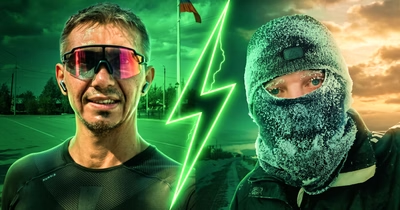

On 5 September 2026, three weeks before the Moscow Marathon, Zhargal Bazarov writes under another morning run: “3 weeks to MM — building form!” For the protocol this is already a second lap: his first Moscow Marathon in the standings was closed a year ago. But to understand what sits behind that short “3 weeks to MM,” you have to go back seventeen months — to where it all started with a confession that has not a drop of heroics in it.
“A sitting life pushed me into it — now running is part of it too!”
A month to the marathon
On 3 April 2025 Zhargal’s first run appears in the URX standings. An ordinary entry from an ordinary newcomer to the league — except for what happened next. Exactly a month later, on 4 May, the protocol does not show a ten or a fifteen. He closes 42.76 kilometres toward Victory 80 — a full marathon distance, only thirty days after the first line in his league tally. That is not a protocol typo and not a one-off surge: it is the pace of someone who decided a sitting life had to end, and did not stretch out the transition.
By September of the same year the distance gets an official name. On 21 September 2025, toward September 35, a one-sentence line drops in: “Moscow Marathon 2025!” — the first real city start, the same one whose second lap he is preparing now.

The hour nobody sees
What follows is not a flash, but a regime. From six to eight in the morning, sometimes a little earlier, sometimes a little later, the home park at Angarskiye Prudy becomes the daily stake. “I mostly run in my home park. League runs fit into that without trouble — my volume lets me take part in almost every race,” he explains the method with no poetry at all. Over seventeen months that method will grow into 2,533 kilometres, 321 runs, almost 217 hours on his feet, 36 different league races and 25 outings longer than a half marathon.
There is a quiet contradiction in this, and Zhargal puts it better than any editor: “Inside the running crowd I’m hard to miss or not recognise” — and then, without a pause: “Family, friends and colleagues back me, but it looks invisible to everyone else: I train from 6 to 8 in the morning.” The recognition is there. Witnesses, almost none — because at that hour the city is still asleep.
The race he nearly lost before it counted
The peak of that first big wave is May 2026, the Kazan Marathon. On 3 May he closes 42.2 km with a short note — “Kazan is a very beautiful city!” — but the real drama unfolds not on the course, but in the interface. On 1 June, already finishing the slot, he writes: “Saturday run. Trying again to log this run toward the race, hope it works!” — an ordinary league athlete fighting not the distance but a registration form, and still seeing it through. The result of that month: first in the absolute, with no age-group split — .execution is closed.
It is not his only win, but it is probably the most sharply cut. In his league career he has four such absolutes — 13, .execution, Francisco Goya and Historic Race 1945. Three more times he is first in his group without the absolute — including Historic Race 1969 and Claude Monet already in season 263. In Nairobi he was not chasing a podium at all — he simply logged 311 km across 36 outings, including a trail between villages in Mordovia, and that was enough for 11th in the absolute: long, even work instead of a sprint for a line.
Not everything you run makes it to the finish
The story has a reverse side, and Zhargal does not hide it. Two big virtual challenges, «Гроза Run» and «ПЕКЛО RUN», sit in his protocol as DNF — even though each has more than 280 kilometres, logged across 41 outings. Not a breakdown and not an injury: the distance simply did not fit the challenge scoring period. More than 550 kilometres in total — and none of it formally counts toward wins. The league records that as honestly as the four absolutes: not every piece of work ends in a medal, but none of it disappears from the history.
The park as his own stands

Even inside marathon prep Zhargal finds room for a five with company: on 8 August, in the middle of a long run toward Buenos Aires, he writes: “Inside my long run — a park race s95 with the guys.” The home park holds him even from far away: “Back from the Mediterranean shores to my home park!” — and on 18 June, over 27.7 km — the last long before the White Nights — he leaves the line that is the whole route: “Back in the home park for a little while — last long run before the White Nights.” He does not write comments under every outing, and not for display — 144 texts on 321 runs, “depending on the mood, some motivation for myself, or maybe for someone else.”
The countdown
It is not will alone that holds the body in a schedule like this. “My coach helps with that,” Zhargal says, and the calendar backs him up: intervals, marathon longs, a short “need to recover…” after 11 km at 4:41 in an especially dense August. August 2026 became the highest-volume month in his whole tally — 22 outings, 255 km — because the countdown to a second Moscow Marathon had already started.
25 July, 25.5 km in Depth 100: “Starting prep for Moscow and the marathon.” 23 August, 32.6 km in Hyperdrive 50: “Still getting ready for MM! Another long run done!”

And here is 5 September again: “3 weeks to MM — building form!” The circle closed — but it did not repeat. A year ago this was a first marathon written onto a sitting life. Now it is a second, and behind him he already has 2,533 kilometres of proof that the April transition was not an accident.
What to keep in running for years ahead, Zhargal puts with no caveats: “If running is a pleasure, it is forever — and I wish that for everyone!”
Zhargal Bazarov is in Spotlight not for four absolutes on their own. He is here because in URX this is what scale most often looks like: not a separate life “for the league,” but the same person who goes out into his park at six in the morning — and a marathon after a month of training, 2,533 kilometres and the countdown to the start turn out to be one and the same story.